Works · Framework Demo

The Missing Adapter Layer for Research Computing

A raw virtual machine is not a research environment. This lightweight, open-source adapter layer — built on k3s and Coder — sits between cloud or local GPU provisioning and the HDR candidate's interactive workspace, turning a cold VM into a reproducible, GPU-ready environment in minutes instead of days.

arXiv Preprint k3s + Coder · open source CI/CD deploy < 5 minutes
~20s
Warm-start workspace vs 10–20 min VM boot
≥99%
Target environment reproducibility rate
<30% → shared
Typical dedicated-VM GPU utilisation, reclaimed

The problem

Four gaps, mapped to three architectural layers

Cloud and infrastructure tools stop at the boundary of the virtual machine. Everything that turns a raw VM into a productive research environment — driver compatibility, self-service access, GPU scheduling — is left to the researcher. Each identified gap maps directly onto one of three layers below.
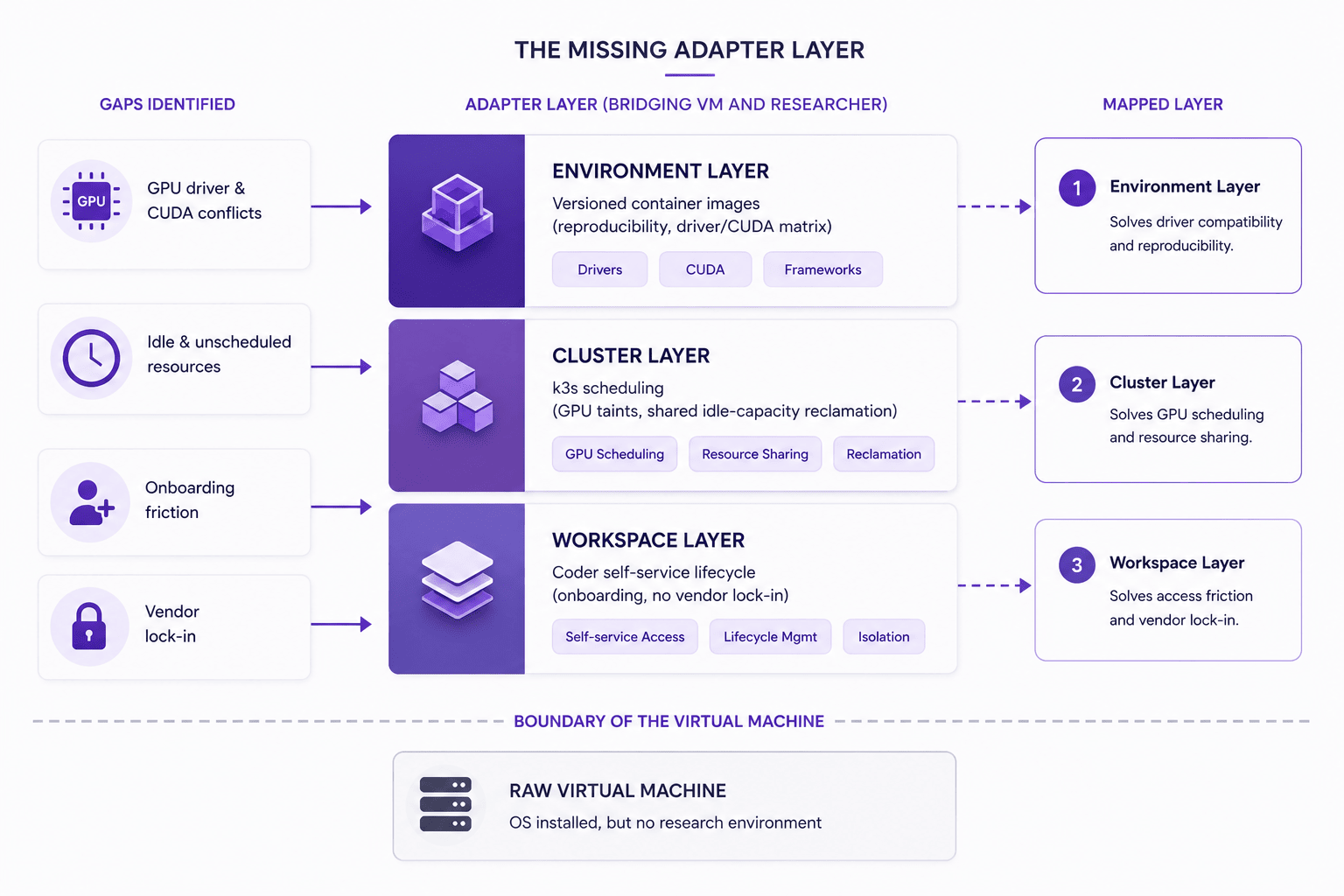
Diagram: four identified gaps (GPU driver & CUDA conflicts, idle & unscheduled resources, onboarding friction, vendor lock-in) mapped to the three-layer adapter (Environment, Cluster, Workspace) that bridges the raw virtual machine boundary and the researcher.

Worked example

Four paths from request to a running workspace

Illustrative example using representative timings from the paper — not a live deployment. Pick a path to see the steps and total elapsed time.

Path
Steps

Total elapsed time

Relative to cloud-VM baseline (20 min)