A GPU-Aware Edge Private Cloud
Skyward Edge runs LLM inference on distributed, low-cost hardware instead of hyperscale GPU clusters — a lightweight, HA k3s cluster interconnected over a secure overlay network, designed to become the foundation of your own private data centre.
The cluster, request to inference
User requests are routed through a load-balancing layer to chatbot services running on the cluster. Inference runs on DGX Spark–based accelerator nodes with large shared memory, giving cost-effective LLM serving without dedicated GPUs on every node. A dedicated control plane handles scheduling and fault recovery across heterogeneous, low-cost hardware.
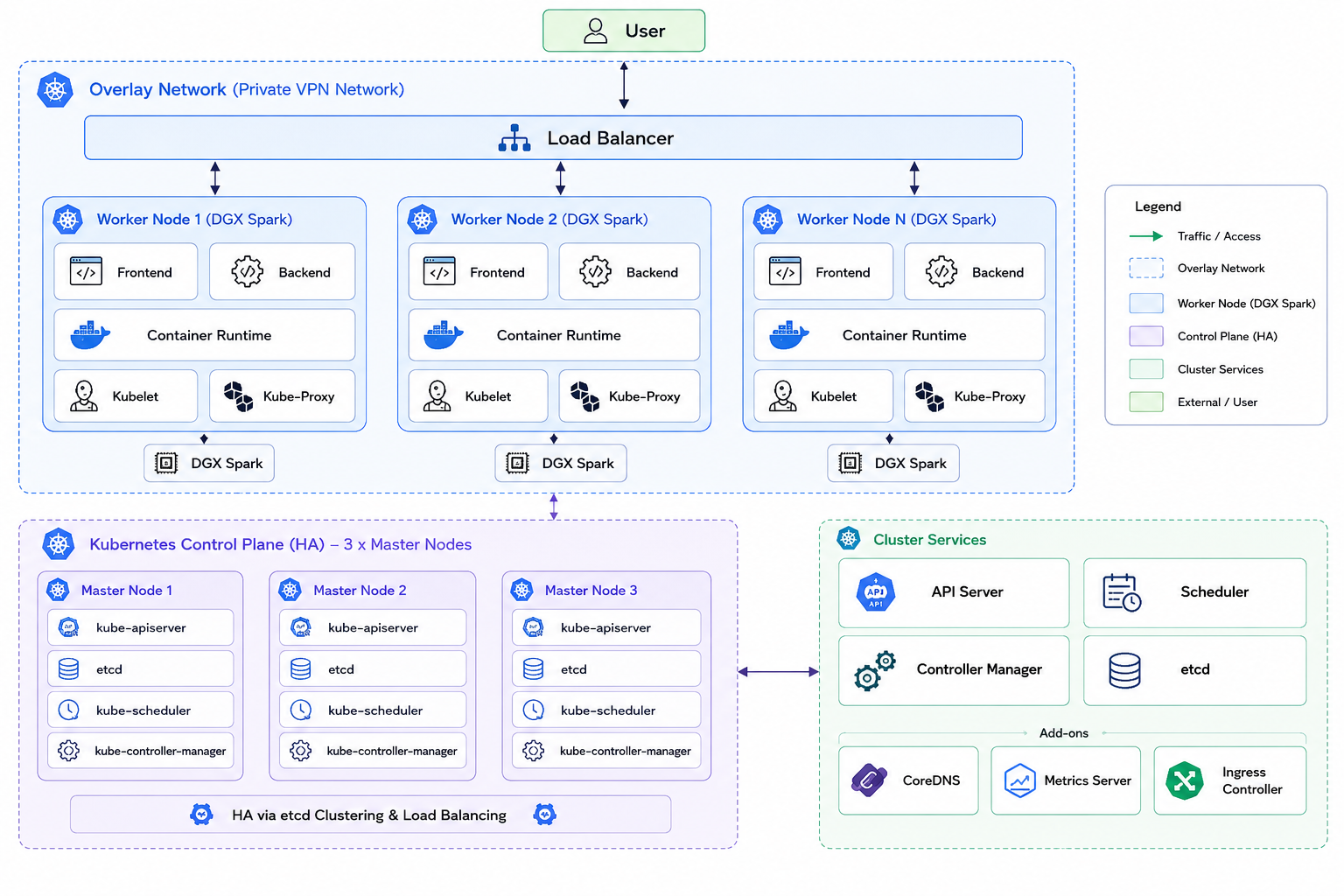
User traffic enters through a load balancer inside the private overlay network, fanning out to DGX Spark worker nodes (frontend, backend, container runtime, kubelet, kube-proxy). A 3-master HA control plane and its cluster services (API server, scheduler, controller manager, etcd, CoreDNS, metrics server, ingress) handle scheduling and fault recovery.
Why this design
Low-cost hardware, pooled
Instead of uniform, high-performance machines, Edge targets heterogeneous, low-cost nodes spanning resource-constrained and edge environments — economically viable for small teams, not just hyperscalers.
Container & tenant isolation
Container-based isolation and per-tenant data access controls reduce cross-tenant interference and limit the blast radius of any compromised component.
HA control plane
A distributed control plane (API server, controller manager, scheduler, etcd) manages scheduling and fault recovery across the cluster, enabling dynamic workload placement and resilient execution under realistic network constraints.
Encrypted overlay network
Nodes are interconnected via a secure overlay network with 60–200 ms latency tolerance — the same zero-config, encrypted fabric that Skyward Mesh provides across the whole platform.